In a 24 hour period, Facebook touts the effectiveness of Sponsored Stories while simultaneously agreeing in a court settlement allow consumers to opt-out. Oops.
How Advertisers Catch Up to Consumers in Social
Facebook and other identity and behavior networks have created new behaviors - and these behaviors have had no trouble attracting the attention of consumers. The new behaviors have been so empowering of consumers, that as they adopt new behaviros, they have learned to tune out advertising even more effectively. Consumers have even learned to kill ads, concepts, and brand strategies they dislike en masse.
Debra Aho Williamson, principal analyst at eMarketer in Seattle, noted that when the firm published its most recent forecast for digital advertising back in February, it projected that Facebook revenue would probably double again this year to $6 billion, a number she said is likely now out of reach.
"Consumers have adopted social media a whole lot faster than advertisers," Williamson said. "It's taking them a lot longer to figure out how to fit social media into their plans. [TheStreet.com]
This gap in "monetization" should be viewed in the context of how all innovation takes time to conquer relevant adoption curves and settle into a business model that works for all participants. With the pace of today's change, we have cases like Groupon, where the vectors of growth point one way, while the sustainiability of the business is highly questionable. This phenomenon in the information sector is likely to continue as the flow of information between market participants becomes effortless. It is even worthy of excellent satire from McSweeney's: Ponzify
So it's not just about your 2 Million app downloads that net you some nice venture funding for "traction" in the marketplace. Make sure you're paying attention to how your users behave, as well as how their behavior change when you add "monetization" strategies.
Watch Facebook's Mobile ad product introductions carefully. If the users hate the products, and find them annoying, intrusive, or unstable, that's bad for the Facebook ecosystem and engenders the kind of hatred consumers have for companies like AT&T, in which they stay with the company but hate it because they cannot easily leave. Conversely, if the consumer ignores the ads, and skps right through them, that's bad for advertisers, who need at least some user attention to get value out of the ads. The holy grail for facebook is helping to identify the ads in the middle: the ads so content-like that consumers will see them as a net benefit.
This is small thinking strategy for Facebook, at best. Which are the two or three brands whose social engagement strategies you like as much as you do their products? Those are the ads that will be premium inventory in your newsfeed. The social experiences that consuemrs want, which are so attractive consumers will seek them out for their value, are the name of the game for Facebook, because these experiences will have to rent access to Facebook's identity network. And that is where the money will be.
Facebook will know the future before you can Tweet it
What were you doing last night? Mark Zuckerberg had a hackathon. Oh yeah, and today his company went public.
I have been thinking about valuation of Facebook all week, and i think whatever the offering price is, it's wrong, and the GM announcement just made things worse by focusing on revenue in the Millions. The valuation should not be based on revenue.
Instead we are looking at the premiere testing ground for defining social expereiences and ad products across multiple channels based on the behavior and reactions of real users. The future is clearly coming, where recommendations and votes of confidence from friends will be louder than advertising. With the end of broadcast, and even the end of web portals, attention is a strategic asset. And Facebook has a boatload of attention, because we are addicted to news about other people.
This need to gossip, and the need to share, is a basic human need- It's Brain Candy, according to Harvard researchers.
To be cute about my hypothesis: Facebook will know the future, ship an awesome product and move on, before you can Tweet it.
To be cute about my hypothesis: Facebook will know the future, ship an awesome product and move on, before you can Tweet it.
Facebook is in a dominant market position to be able to take the attention people spend on the platform, across devices and all over the social web, to find out what works before any of their competitors, and with enough scale to stay ahead. As long as they do not piss off users (the product being sold to advertisers) then the business is incredibly valuable. I don't really know how to value it, but you must imagine some of these platforms competing with each other, and almost no one can compete with Facebook in this regard.
It comparatively easy to build a behavior network to scale, but people are growing tired of joining new identity networks - they already have Facebook, or Linkedin, or Google, and it is so easy to get traction by just riding over the top of that; consumers will begin to expect it. Such a strategic advantage is incredibly valuable, and suggests that Facebook might even have a business when many of these other platforms just get boring. Facebook will be the social layer people use - and that could echo for a decade or more.
Facebook keeps saying they are not trying to be a great company, they are trying to make a great product, and while the effects are similar the emphasis contained therein produces really remarkable results. So don't worry about getting the valuation right, because they are going to ship a lot of code before anyone figures out the generational shift in behavior and advertising we're in, but I think Facebook might be the company that gets there first.
Facebook stock closed barely above the offer price - find me someone at Facebook who really cares about that, instead of shipping a great product. Their strategy? Culture as strategy. Facebook tries to get people to enjoy but not flaunt their wealth and these norms suggest that inside Facebook is brewing...the next Facebook.
Behavior Networks and Identity Networks
Instagram's acquisition by Facebook illustrates how the tension between identity networks, and behavior networks will play out in the marketplace, and how it may not benefit users directly. This divide pits sites like Pinterest and Instagram vs. Facebook, Twitter, Path, and others.
Identity networks, like Facebook and Linkedin, focus on You and managing connections to pieces of identity, and while you may have have wide-ranging conversations within such networks around content, which are key to communicating your identity, the profile remains the anchor point to an identity you care about. Facebook deserves credit for making this idea popular and easy to understand - forcing Google and Microsoft to change in many ways.
Facebook's Connect and Open Graph initiatives show how crucial the concept of identity is to the Facebook model- the advertising Facebook sees in the future isn't customized by cookie pools, it's customized based on the open graph. It's not limited to Less and less of the meaning that users derive from being Facebook users will come from using Facebook.com and more and more will come from experiences enabled by the Facebook Platform. Facebook, as it extends the platform, is admitting that it cannot innovate fast enough at the edge to keep every user fully engaged - what they want is to have that user identified and authenticated, pulling their behavior into the Facebook ecosystem.
Thus, the edge of the platform, powered by identity, is where new user behaviors will emerge. These emergent groups of connections, I call Behavior Networks. They have several important properties.
- Leverage an identity network to authenticate users - e.g. social sign in
- An intentionally narrow feature set, the novelty of which self-selects new users.
- User to user value exchange is based on behaviors - e.g. who you are on Pinterest is DEFINED by what you pin.
- Nonlinear growth in user base enabled by the Identity Network.
- Scale is the enemy of behavior networks, because they represent the end of novelty (2).
Behavior networks remain rooted in one style of behaving, and are key to a very specific context or action. Instagram and Pinterest are in this category. While relying to varying degrees on your identity (on Facebook, Twitter, etc) your identity on these sites defines your behavior - if you never publish anything, you don't exist. No matter how many instgram photos you take, that's all the network says about you.
Test yourself, when was the last time you deleted an Instagram photo? When was the last time you deleted a Facebook post? I've done many of those things on Facebook, but I never worry about Instgram.
The real-time web is perfect for behavior networks. All that matters is what you are doing- your behavior is your only identity but it doesn't live forever.
For these reasons, these behavior networks represent a challenge for marketers. Extending engagement beyond the behavior network - site traffic, conversions and so on - will be used to prove that the marketer's participation had some value. And this will require functionality a behavior network operator will be loathe to construct. All ROI metrics will come down to this: did the users engage further? Did they pin stuff and their friends bought it? The ROI analysis will require a channel linked to identity. So as marketers we face the dilemma of proving the value of engagement beyond behavior networks, and these are uncertain times indeed.
My next two posts on this topic will deal with:
- Path, Twitter, LinkedIn and Foursquare: Can there be more than one identity network
- How will the tension chnage the practice of marketing?
Why Pinterest is A Fad
Consumer attention is finite, but so is your marketing department. Pinterest reached scale quickly, and I commend it for its 10 million users, but are those users so invested that the next “thing” won't become just as hot by rising 50% faster? How much of your social media team's time are you willing to bet?
How to Get More From Your Brand's Facebook Data
I was pleased to be quoted in the Ad Age "Relationship Issue" about how brands are increasingly using enhanced strategies to cull insights and marketing intelligence from Facebook Data. The article about marketers use of Facebook data appeared in the same issue as my colleague Gregg Hamilton who commented very real possibility of consumers owning shares in brands.
Building an application, as I noted in the hypothetical example of an airline, is one way to go, and as long as the value is there for the consumer, the financial investment is probably sound. But strong consumer insights are key to making sure this is about value delivered to the consumer, not just meeting your marketing goals.
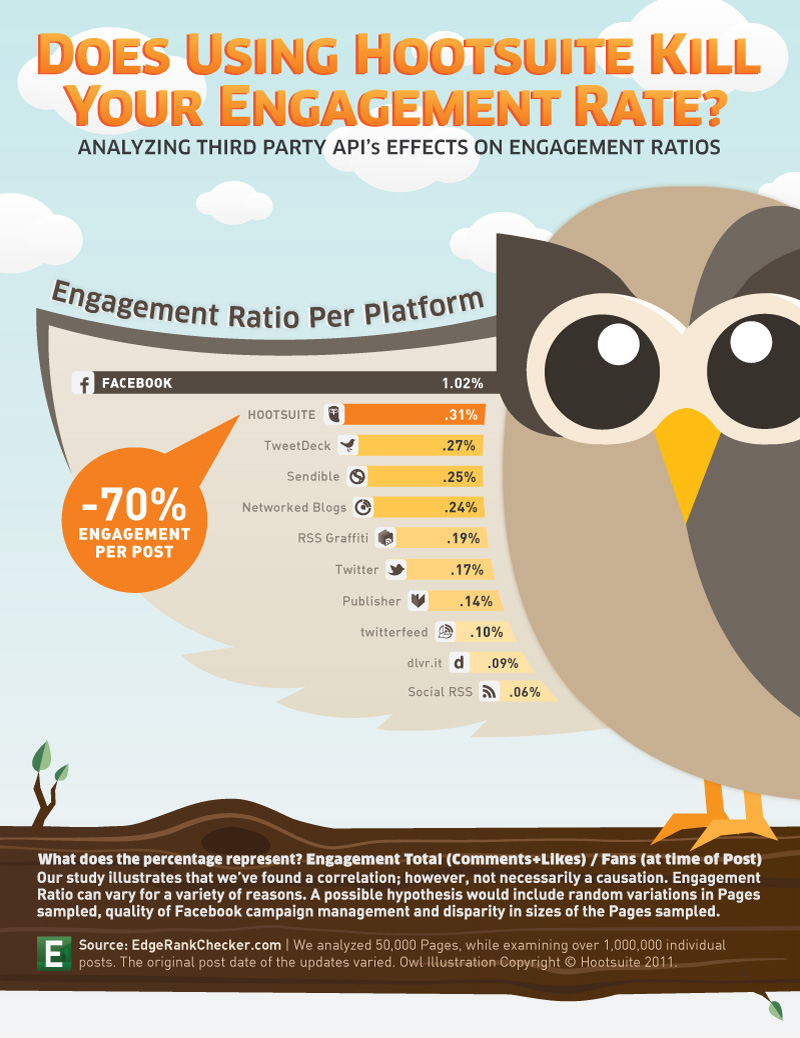
Does Using HootSuite Kill Your EdgeRank?
There are so many myths about what fans like, but we're strarting to understand that what one person sees on Facebook or Twitter reallys isn't predictable- their graph will determine what they see, and Facebook now gives brands more headachess than ever for getting into the newsfeed.
A possible answer to this is the rising numebr of studies which use the facebook API, and largwe scale data collection, to break news about what may be happening to page content (with the implicit point that most of thye a brand's fans will engage via tyhe newsfeed rather than coming to the page).
Solid analytcis, have been published on this topic, such as Facebook Engagement analysis from Visibli or L2's Facebook IQ. A new study by EdgeRank Checker -suggests that using Third-party applicationsto post to facebook results in the creation of content that gets lowerr engangent than native Facebooks posts.
There are a variety of reasons for pages to want a managed publishing solution, including regulatory, workflow, manpower, and moderation, in additon to those you'll also hear in the sales pitches from Buddy Media, Vitrue, Involver, and the others named below.
So what is the enterprise digital social strategist to do? Never, ever, take the top line conclusion from the vendor and appluy it to your bsuiness. Ask for data about your client specifically. Dig into which pages were used.
For example, there are so many tiny fan pages doing a terrible job with mediocre nontent, I bet the amouint of objects created by those pages dwarfs the major brand pages. We've all seen those pages. I'll be digging in, let's see what else EdgeRank can tell us.
GOOG 3G/4G Spectrum Patents from Nortel Key to World Domination
Over at SAI, the chart of the day suggests that ChromeOS is a jab at Windwows (duh) and that Google needs the OS to succeed because it is the best hope to kill a weaker Microsoft. Despite Microsoft's attempts to break out of the doldrums, and the extreme diversification of their product offerings (many of which never stood a chance of working)- Windows remains the cash cow for the giant.
If I were Google, I wouldn't try to win the war against Windows under current conditions; I would need more things to fall into place.
Android users are wising up to the Google Platform, and applications for Android are proliferating. Windows Phone 7, how are you feeling?
Bing is getting better, has differentiated itself and is integrating with Facebook more obviously (the future of social search is very scary for any company that does not follow Bing's lead)- that's got to be scary for Google.
ChromeOS apps would all be web apps, and the value proposition would have to involve the cloud, and applications that are enhanced by always on-data networks. WiFi in the current sense just will not cut it. You know what would? 3G/4G wireless connectivity built in.
ChromeOS laptops might be a miserable failure like the Nexus one, but if Google sold them at a loss, they'd exact a far more painful loss on Microsoft. With onerous license fees from the essential connectivity, Google has to own the key patents in order to reduce its costs. This illuminates why Google may be fighting so hard against Apple and RIM for Nortel's 3G/4G patents.
When yo sign into Google Apps, use email, docs, spreadsheets, watch Youtube videos in the Chrome browser, and android apps all day, getting served advertising by Doubleclick until you remotely program your Google TV from your android phone and watch The Office when it's convenient for you...that's when Microsoft dies. And with the exception of GoogleTV, I haven't named one thing above that sucks.
To do the same thing on Windows/microsoft/Bing/MSN/Xbox, you're making some compromises along the way, for sure. It's not a done deal, but it's for all the marbles.
Who cares if the cool kids leave Facebook?
The cool kids are leaving Facebook, says Pace Lattin based on data from InsideFacebook: the 18-35 demographic is now having negative growth in this "early adopter" demographic. I can't yet find the raw data, but let's assume the trend is true. Let's assume that the explosive growth of Facebook for mobile doesn't have anything to do with it.
Any platform that requires the "cool kids" to be there for it to be successful will ultimately suffer the same fate. We can't all be East Village hipsters enjoying our own exclusive online party, with VCs chomping at the bit to try to invest in the things we think are cool. Even if all the cool kids leave, Facebook will still have a huge business with the uncool kids.
However. Viewing Facebook itself as the cornerstone of social is just false. They beat out all the other social networks, more or less. Round 1: Facebook. Bigger, longer term, the interoperability of social graphs will make the choice of any one web site unimportant.
Any platform that requires the "cool kids" to be there for it to be successful will ultimately suffer the same fate. We can't all be East Village hipsters enjoying our own exclusive online party, and there will continue to be plenty of business opportunities for Facebook even if those users leave.
However. Viewing Facebook itself as the cornerstone of social is just false. They beat out all the other social networks, more or less. Round 1: Facebook. Bigger, longer term, the interoperability of social graphs will make the choice of any one web site unimportant.
The fact is, hipsters still have parents, and teachers, and friends they want to connect to, and some they want to be able to ignore. Technologies built on opening the social graph and intelligent selectively sharing the content we ourselves consume is the direction we're heading.
Round 2: unknown.
we haven't really seen the companies that are thinking about this. Check out where Diaspora is going these days, and see the interoperable social future.
Your privacy's fate: Sealed with a Click
I grabbed this just now on my Facebook home page: a sponsored Link with the Gmail/AOL/MSN logos, and my email address in bold, Thanking me?

I normally would have ignored it, but frankly I was curious. I clicked. The result, however, was insidious:

So now I can see what the plan is- Facebook wants to keep an eye on your Google account to make sure you don't connect to someone by email without also connecting them to Facebook.
It's hard to know what the cumulative effect of constant authorizations, approvals, and stored passwords really is, but I predict one day it sneaks up on you, an accidental overshare or ads that seem to insidiously follow you whenever you want? A friend who lands on a site they hate, to find out that you praised it before you knew how much it would offend them?
Or will it be merely the insidious, price-discriminatiung ad where you get to fly to Fort Lauderdale for $389, but your friend flies the same itinerary for $250 with a free checked bag?
Scary? Only sometimes. But it all started with one click.
Cause Marketing: We see you!
A facebook friend liked a Facebook ad by a Philly-based Bongo Agency, so I went to see what this agency was doing with Facebook. I discovered an interesting question about Cause Advertising.
KFC's pink buckets are a great example. My response in the FB thread:
What continues to baffle me about KFC is the unhealthy element of their food. Even if they are supporting breast cancer research, I feel like the brand is mobilizing moms to make their families fat. Breast cancer is a worthy opponent (my mom is a survivor), but what about obesity and heart disease? What about teaching kids healthy eating habits?!!
I think a more thoughtful tie-in between the brand/product and the cause is key to making cause marketing successful.
I read the other day that the American public is essentially addicted to low prices and discounting in retail; until we agree that we will pay more for higher quality, healthy, safer products, that are better for the environment, I think marketers will rely on Cause marketing to use philanthropic sentiment to justify a premium price.
What do you think?
PS: don't miss, from the new Saatchi blog: 10 Ways to Communicate with Moms.
Success for Foursquare is in the Cloud
I enjoyed Caroline McCarthy's questions about Foursquare's sustainability.
But let's not limit the definition of success to the Foursquare product as it stands-the API is where the real action is.
Venue and advertiser innovation will drive the platform's success, as with Twitter. Businesses and marketers can leverage the Foursquare platform to create engaging experiences wherever people gather, and they don't need to wait for Foursquare to make this a default behavior.
Marketers are dipping their toes in to the water of location-based social networking, using the game elements of Foursquare to enhance their marketing programs, but few are creating brand-relavent and ongoing experiences that add value for the user.
As users tune out broadcast messages, marketers will turn instead to memorable, high-ROI experiences in the real world that leverage Foursquare, or Yelp/Facebook checkins, or Gowalla, or the application we are all going to be using tomorrow. Each of these is just another doorway to reach today's hyperconnected audience- and all their Foursquare friends.